
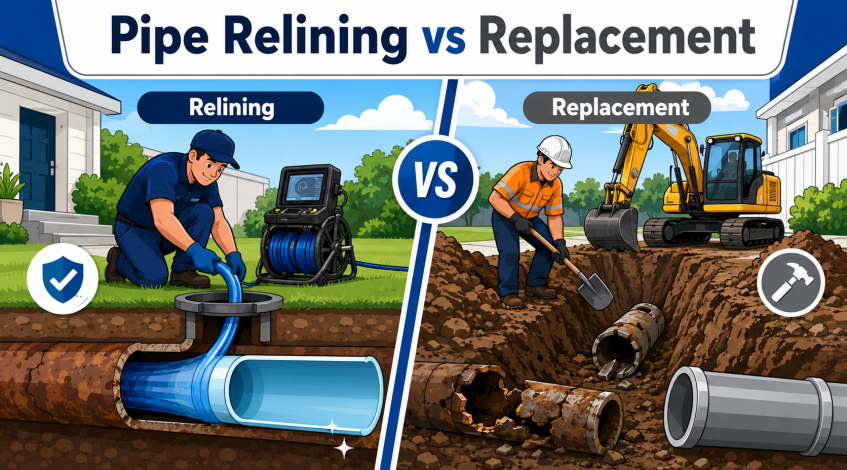
Somewhere along the way, you might have heard whispers in plumbing circles of this almost too-good-to-be-true trick – a totally busted pipe getting fixed without anyone touching a shovel. No trench across the lawn, no jackhammer through the driveway, just some clever wizardry that seals everything up from the inside. That’s pipe relining, and yes, it’s real. But it’s not always the answer – sometimes the yard genuinely does need to come up, and that’s where pipe replacement still earns its keep. So, today, we’re taking a deep dive into pipe relining vs replacement.
So how do you know which camp your pipe problem falls into? Here are the 7 critical factors that actually decide it.
1. How bad is the damage, really?
This is the big one – and it also answers upfront what is pipe relining.
It works by inserting a new lining inside your existing pipe, which then cures and hardens into a smooth, durable new inner surface. But for that to work, the original pipe needs to still have enough structural integrity to hold its shape while the lining goes in and sets.
For things like cracks, small fractures, root intrusion, and general wear and tear, relining handles all of that beautifully.
But a pipe that’s partially collapsed, badly crushed, or missing entire sections? That’s asking the lining to support something with no scaffold left to support it – which is where pipe replacement vs pipe relining tips firmly toward replacement.
2. What’s the pipe made of & how old is it?
Older clay and concrete pipes are common candidates for relining because their damage tends to be cracks and joint separation rather than total structural failure.
Pipes that have genuinely reached the end of their working life – meaning they’re crumbling and deteriorated beyond the point of holding a new lining – usually need full replacement instead.
3. How long is the damaged section?
Relining works brilliantly for damage that runs along a defined section of pipe – even a fairly long one.
But if the damage is scattered across multiple disconnected points, or if practically the entire line needs attention, the cost and complexity of relining each section individually can tip the scales back toward simply replacing the whole shebang.
4. Is the pipe in an awkward or inaccessible spot?
This is genuinely one of the places where pipe relining vs replacement gets interesting, because it’s often the opposite of what people expect.
A pipe running under a driveway, a patio, mature landscaping, or even part of the house foundation is exactly the scenario where relining shines – no digging through any of that means no rebuilding any of that afterward either.
If the pipe is sitting in open, easily accessed ground with nothing of value above it, the access argument for relining matters less, and replacement becomes a much more even contender.
5. What’s the pipe’s diameter & shape?
Relining technology works across a wide range of pipe diameters these days – but unusual pipe shapes, significant diameter changes along the run, or multiple bends in quick succession can complicate the relining process.
Straightforward, consistent pipework is the easiest candidate. Complicated layouts sometimes push the decision toward replacement simply because it’s more straightforward to execute.
6. What does the camera actually show?
None of the above matters until someone’s actually looked. A CCTV drain camera inspection is always the starting point – it’s how a plumber sees the real condition of the pipe rather than guessing from symptoms alone.
The footage tells the story:
- Is this a pipe that’s cracked but intact?
- Is it a pipe that’s genuinely given up?
7. What’s the cost difference, really?
This is the part everyone actually wants to know, and the honest answer is: it depends!
However, relining is very, very often the cheaper option.
Sewer pipe relining vs replacement avoids:
- Hefty excavation costs
- Landscaping restoration
- Driveway or paving repair
- The labour time that comes with digging a trench and filling it back in.
Relining sewer pipe vs replacement comparisons consistently show the no-dig option coming out ahead on price for jobs where it’s a genuine candidate – which is most of the time, provided the damage isn’t too severe.
The pipe relining vs replacement cost differences narrow considerably on shorter, simpler jobs, and widen significantly on anything involving substantial excavation, surface restoration, or hard-to-access pipework. But as a rough rule: the more disruptive a replacement job would be, the more relining tends to win on price as well as convenience.
Why pipe relining is often better AND easier
Here’s the bit that surprises people: pipe relining isn’t just a cheaper, less disruptive cousin of replacement – in plenty of ways, it’s genuinely the superior outcome when it’s available.
No digging means no collateral damage: Your driveway stays a driveway. Your established garden stays established. Nobody’s filling in a trench and hoping the grass grows back the same.
The new lining is seamless: Unlike old pipe sections joined together, a relined pipe has no joints along the relined section – and joints are exactly where root intrusion and future cracking like to happen. Fewer joints generally means fewer future problems.
It’s often faster: A relining job can frequently be completed in a single day. A full replacement involving excavation, pipe laying, and backfilling takes considerably longer, especially once you factor in surface restoration afterward.
It resists root intrusion better going forward: That smooth, jointless new surface gives tree roots far less opportunity to find a way back in, which is a genuinely common cause of recurring blockages in older pipework.
None of this means relining is always the right call – when the damage is too severe or too widespread, it’s simply not an option, and that’s fine. But when a plumber tells you relining is on the table, it’s worth understanding that you’re not settling for second best. You’re often getting the better outcome with considerably less mess.
Get the right answer for your particular pipe
The only way to know for certain whether your situation calls for relining or replacement is a proper inspection. Best Plumbers Club connects you with real, genuinely-recommended and vetted licensed local plumbers who can assess your pipework, run a camera inspection, and give you an honest recommendation – not just whichever job is more profitable for them.
Call or request your no-obligation quote online today.
Related posts:
 Is Pipe Relining Worth It? Costs, Lifespan, Pros & Cons Explained
 How a French Drain System Protects Your Yard from Flooding
 Cold Plunge Plumbing: Installation, Care, And Troubleshooting
 4 Drain Cleaning Tools Used By The Best Plumbers
 How Much Does Toilet Installation Really Cost?
 The Truth Behind Rainwater Tank Installation Cost