
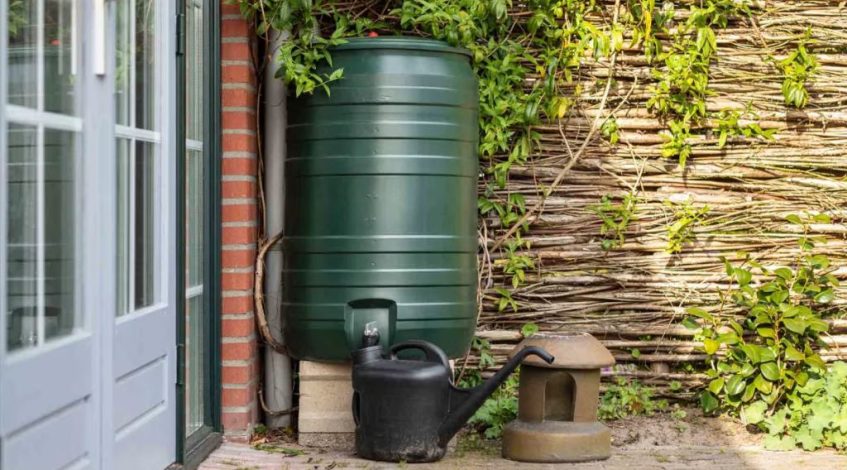
There’s a version of this job that’s genuinely simple – a standard tank on level ground, close to a downpipe, no internal connections needed. Straightforward to quote with minimal variation, right?. And then there’s every other version of the story. And it’s that gap that is why the rainwater tank installation cost can look so different from one property to the next.
It’s not that plumbers are pricing arbitrarily. It’s that the scope changes considerably depending on:
- Your specific site
- Your existing plumbing
- What you actually want the system to do.
We’ve put together a guide that explains what’s really driving that rainwater tank installation cost quote variation.
The factors are:
1. The tank itself
Size and material are the obvious starting points when it comes to the cost of rainwater tank installation.
Larger tanks:
- Cost more to buy
- Need more space
- Often require more substantial foundations.
Polyethylene is the most common residential choice – and it’s practical and cost-effective. Steel and concrete suit certain situations but carry different price points and installation requirements.
So understand that while the tank is a significant part of the total cost of rainwater tank installation, in most jobs it’s not where the complexity really lives.
2. Where it goes on your property
Tank placement matters more than most people expect. A tank sitting close to an existing downpipe on flat ground with clear access around it is about as clean as it gets.
However, you may want to:
- Move it further from the downpipe
- Put it on a slope
- Tuck it into a tight side passage.
And then the job starts to involve trenching, levelling, and additional pipework. Nothing exotic – it just takes time, and time is what you’re paying for.
3. What the ground underneath needs
Every single tank needs a stable, level base. And for smaller tanks, compacted gravel is often sufficient.
But for larger ones, a concrete slab or reinforced support may be necessary – because a full tank is considerably heavier than an empty one, and an unstable base causes real problems over time.
So what’s required depends on the tank size and the condition of the ground underneath.
4. What a plumber actually does on the job
This is where the work gets a bit more technical – and where a licensed plumber really earns their place on the job.
Connecting a tank to your downpipe system isn’t just running a pipe from A to B.
It typically involves installing a first-flush diverter, which discards the initial roof runoff – the part carrying the most debris and contamination – before water enters the tank.
Overflow management also needs to be properly designed so that when the tank reaches capacity, water is directed safely away from your foundations.
And for internal connections, the scope of the job increases … a lot!:
- Supply lines, for example, need to be run and then pressure-tested, and precisely and correctly integrated with the household system.
- A mains switchover valve is required so that when the tank runs dry, supply defaults back to mains automatically without any interruption.
- And all of it needs to meet current plumbing code requirements – which in Queensland means specific compliance standards around how rainwater systems are installed and certified.
5. Plumbing rainwater into your home
This is where a lot of homeowners underestimate both the complexity and the importance of getting it right – connecting a rainwater tank to internal fixtures.
What are you thinking of plumbing your tank to?:
- Toilets?
- Laundry appliances?
- Maybe even hot water?
For all of that, you’ll need a dedicated dual-pipe system that keeps the rainwater and mains water completely separate. And this isn’t optional, either. Cross-connection between potable and non-potable supply is a serious health risk and a plumbing code violation.
- Non-potable lines must be clearly identified, typically with purple pipe or compliant labelling, so they can never be confused with the drinking water supply during any future maintenance or renovation work.
- Fixtures need to be suitable for rainwater use.
- And in Queensland, internal rainwater connections generally require council approval and must be carried out by a licensed plumber who can certify the work.
It’s at this part of the job that we’re really separating a proper installation from one that just looks finished. It’s also the part where cutting corners creates the most risk.
6. Pumps, filtration & supporting equipment
Gravity-fed systems work for some outdoor applications, but internal use and reliable pressure require a pump.
So, depending on the system, you may also need:
- Filtration units
- First-flush diverters
- Backflow prevention devices.
They all add meaningful functionality – particularly for households serious about reducing mains water reliance – but they also add to the upfront cost as well.
Getting clear on your intended use early helps avoid either over-speccing or under-building the system.
7. New build versus retrofit
A new build is the cleaner scenario. Why’s that?
Because:
- Plumbing can be integrated from the start
- Purple pipe runs can be planned in advance
- There’s no finished structure to work around.
If we’re retrofitting a tank to an existing home, that means adapting downpipes; on the other hand, that means finding routes for new pipework and working within the constraints of what’s already there. That additional complexity is one of the more consistent cost drivers in the overall cost of rainwater tank installation.
What most homeowners can expect to pay
As a rough guide for average Australian properties:
Basic external installation: $1,000-$3,000.
Integrated systems with pump, filtration & internal connections: $3,000-$6,000 plus.
Larger or more complex setups: can exceed that by a little or a lot depending on scope.
Remember, these are starting points, not quotes! The actual rainwater tank installation cost for your property depends on what a licensed plumber actually finds when they assess the specific job.
Getting a number that actually means something
Online estimates give you a helpful ballpark – but nothing more than that. To increase the resolution, a plumber will need to assess:
- Ground conditions
- Access
- Intended use
- Compliance requirements
- Existing plumbing.
And it needs to be done in-person before any figure is really reliable.
Best Plumbers Club connects homeowners with trusted, licensed plumbers who can do full property assessments as well as recommending the perfect system for you – all with clear, reliable, upfront pricing. Request your quote today!
Related posts:
 What Should You Do When Your Gutters Overflow?
 How Much Does Toilet Installation Really Cost?
 A Homeowner’s Guide to Plumbing Problems and What You Should Do
 Leaking Hot Water System Troubleshooting & Repair
 How To Fix A Slow Filling Toilet Tank
 Is Pipe Relining Worth It? Costs, Lifespan, Pros & Cons Explained